

Size DOES matter…
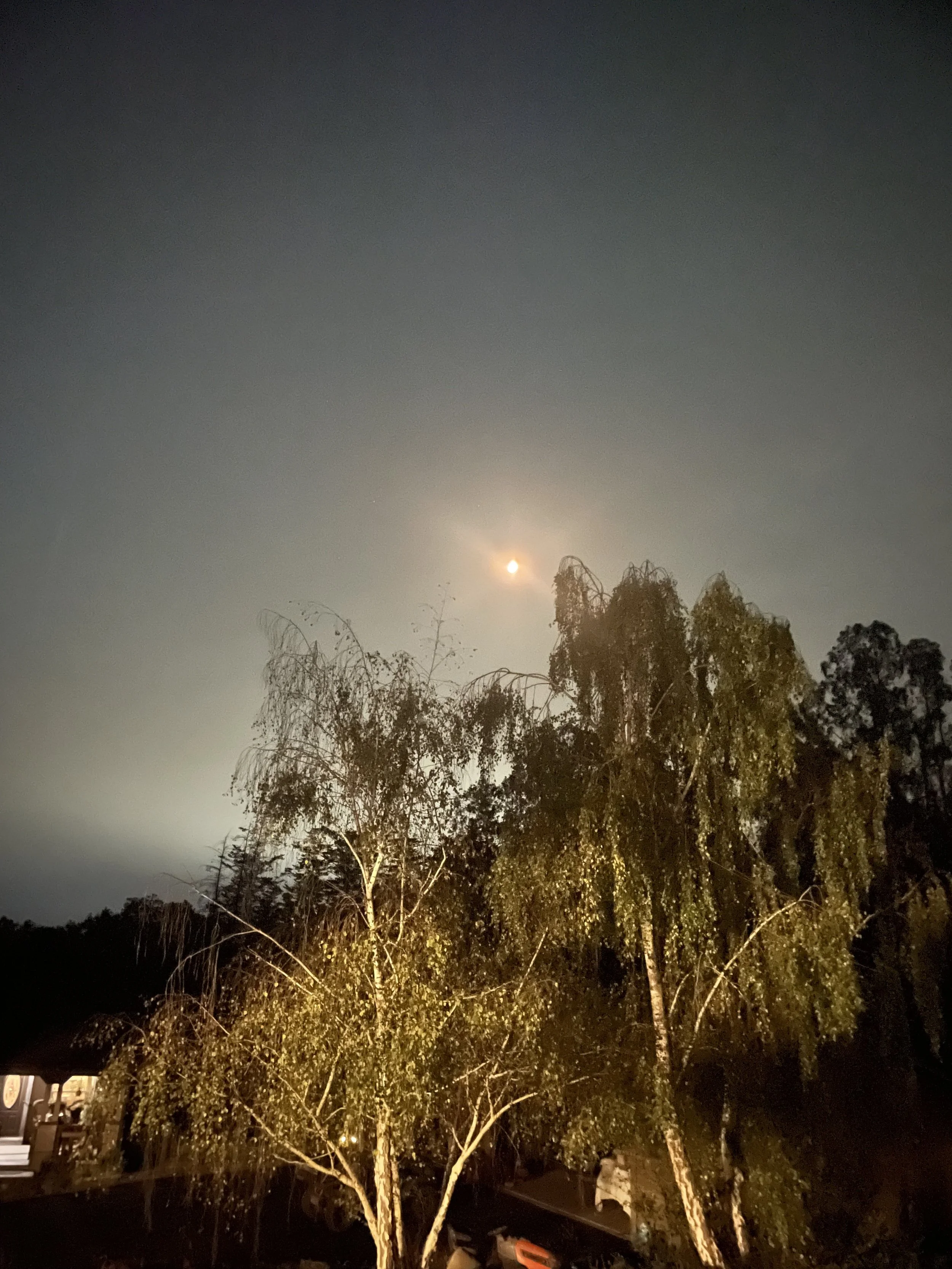
On August 22, 2026, the moon was in a Waxing Gibbous phase with about 70% to 72% of its lunar disk illuminated.
The waxing moon hung in the sky, bright and orange. Damp coastal mist blanketed the tree line beyond the barn. the musicians packed up and the people who often leave before bedtime had not left.
I scanned the crowd, checking names off a list I had built weeks earlier - those with morning departures, the ones with long hauls home, the people who do not stay out past dinner. Many of them lingered amongst the bales and booze. Some of them, leaned against horse stalls. One, holding a plate of fudge and gesturing with it drunkenly.
Austin and I never did our exit. And it didn’t occur to either of us to leave before the rest had gone home.
I’ve thought long about why that happened, and the answer I’ve tumbled into has nothing to do with the food or the music… clearly.
Before I planned an event for a hundred people on my family’s property, I asked the question everybody asks. Is there enough room? I heard it from other people too, repeatedly. A hundred people is a solid number. The growing concern amongst those who know the space revealed a common instinct: to spread out.
But that instinct is wrong.
Let us start with an image we all know well. A hole-in-the-wall restaurant packed with full tables feels alive. People squeezing by, hands on shoulders, quiet ‘scuse me’s and pardon my reach’s. Lively. Full. Connected. Like a neighborhood bodega on a Sunday afternoon. Or a condo stoop downtown. Even your sisters tiny college apartment living room. But take those same people and put them in a spaces three times the size. The restaurant quiets down. The bodega takes orders from strangers who don’t have reason to speak. The porch feels like an outpost. The living room looks empty. Each feels separate. If the goal in gathering is connection, the answer is clear which space lends itself to community.
Our event taught me a valuable lesson in scale as it relates to human connection. Density is not a byproduct of interaction. Density is one of the ingredients that makes new interactions natural.
Whyte found the same pattern in public plazas and gave it a name: effective capacity. After observing that plazas tend to be self-leveling, and that the spaces carrying the most people were not only the most efficient but the most pleasant to be in.[1] That finding embarrassed many of the profession’s prevailing assumptions. Generous square footage per person was supposed to be the amenity, right? But it didn’t look that way to Whyte.
The psychology underneath it is more interesting than “people like crowds,” because people demonstrably do not like crowds. Decades of crowding research is fairly grim on this point, honestly.[2] But a study of two crowd events, an outdoor music event and a march, found something that reframes it. Participants who identified with the people around them reported feeling less crowded at the same physical density, and were more likely to position themselves toward the dense center rather than the edges. Positive emotion followed.[3]
Density is not the variable. Shared identity is the variable. Density is what shared identity feels like from the inside, I think.
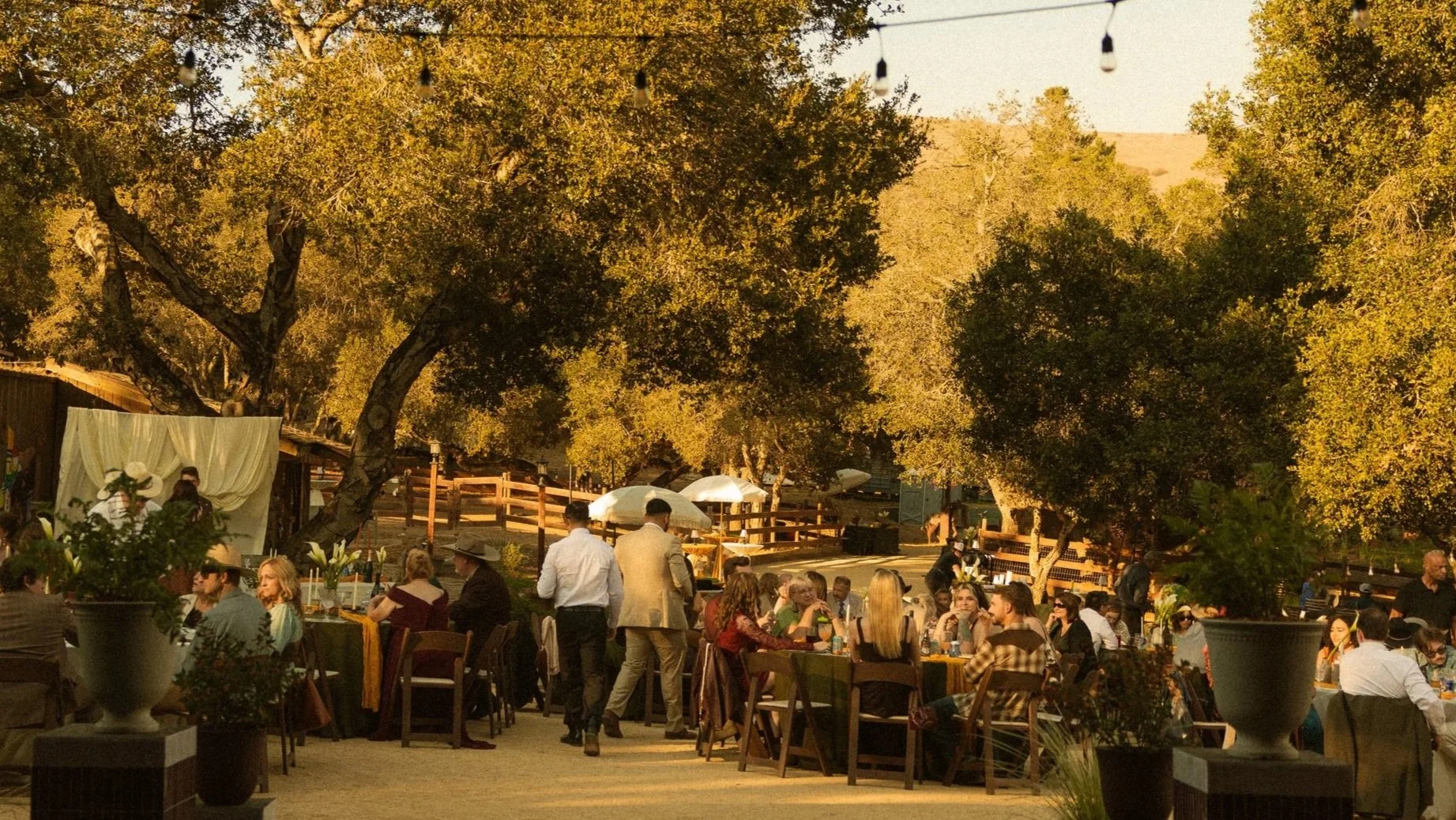
Photo Credit: Kolby Danielle Photo
Which is exactly the condition a well-hosted event manufactures. Everyone in that space was invited by the same two people, for the same reason, on the same night. They already had what the research says you need. Compressing them into a smaller footprint didn’t make our guests feel crowded. It made them feel like they were among their own.
There is a second effect that nobody talks about. In a dense room, no one is exposed. If you have ever stood alone at a sparsely attended party, you know precisely what I mean… you are visible from every angle, and every choice you make about where to stand is a public statement. Put those same people shoulder to shoulder and the individual disappears into the group. Being unremarkable is a form of comfort. A guest who isn’t being watched can relax, and a guest who can relax will talk to a stranger.
Then there’s the argument I find hardest to counter, which is financial.
Every square foot you commit to has to be paid for. Not only in dollars, but in warmth, in lights that have to be hung, in a surface that has to be walked on, in something to look at, in a reason to be there at all. A large footprint spreads your resources into a thin film. Oppositely, a small footprint concentrates them.
I made choices that reflect this and I’d make all of them again. I brought items from home to make each table unique. Opted for small candles for close range lighting. I hired local vendors, smaller operations, people whose reputations were attached to the work in a way a large company’s never is. And I put all of that into a compressed area where guests were close enough to actually see it.
The seating areas were small. The lounge was small. The distance between the food and the music and the place you’d stand to talk was small. Every dollar landed inside somebody’s field of view.
The takeaway, plainly:
Estimate the space you think you need for your guest count. Then reduce it. You are almost certainly overestimating.
Design the smallest footprint that still allows circulation, and let the edges of the property be scenery instead of program.
Concentrate your budget and your labor inside that footprint. Resist designing anywhere a guest won’t be standing.
The real constraint is rarely square footage. It’s parking, restrooms, and power. Solve those and the space question mostly answers itself.
If you have been telling yourself you can’t host because your yard is too small, I’d gently suggest that your yard is the right size and your expectations are borrowed from a venue that needed to sell you square footage.
What would you actually do with the space you have, if you stopped apologizing for it?
Sources for this post
William H. Whyte, The Social Life of Small Urban Spaces (1980), ch. 7, “Effective Capacity.”
For a survey of the crowding literature and its generally negative findings, see the SAGE Encyclopedia of Human Relationships entry on crowding, which distinguishes social density from spatial density.
Novelli, Drury, Reicher & Stott, “Crowdedness Mediates the Effect of Social Identification on Positive Emotion in a Crowd,” PLOS ONE (2013). Two field studies, n=48 and n=112.
