

All Good Things in Threes
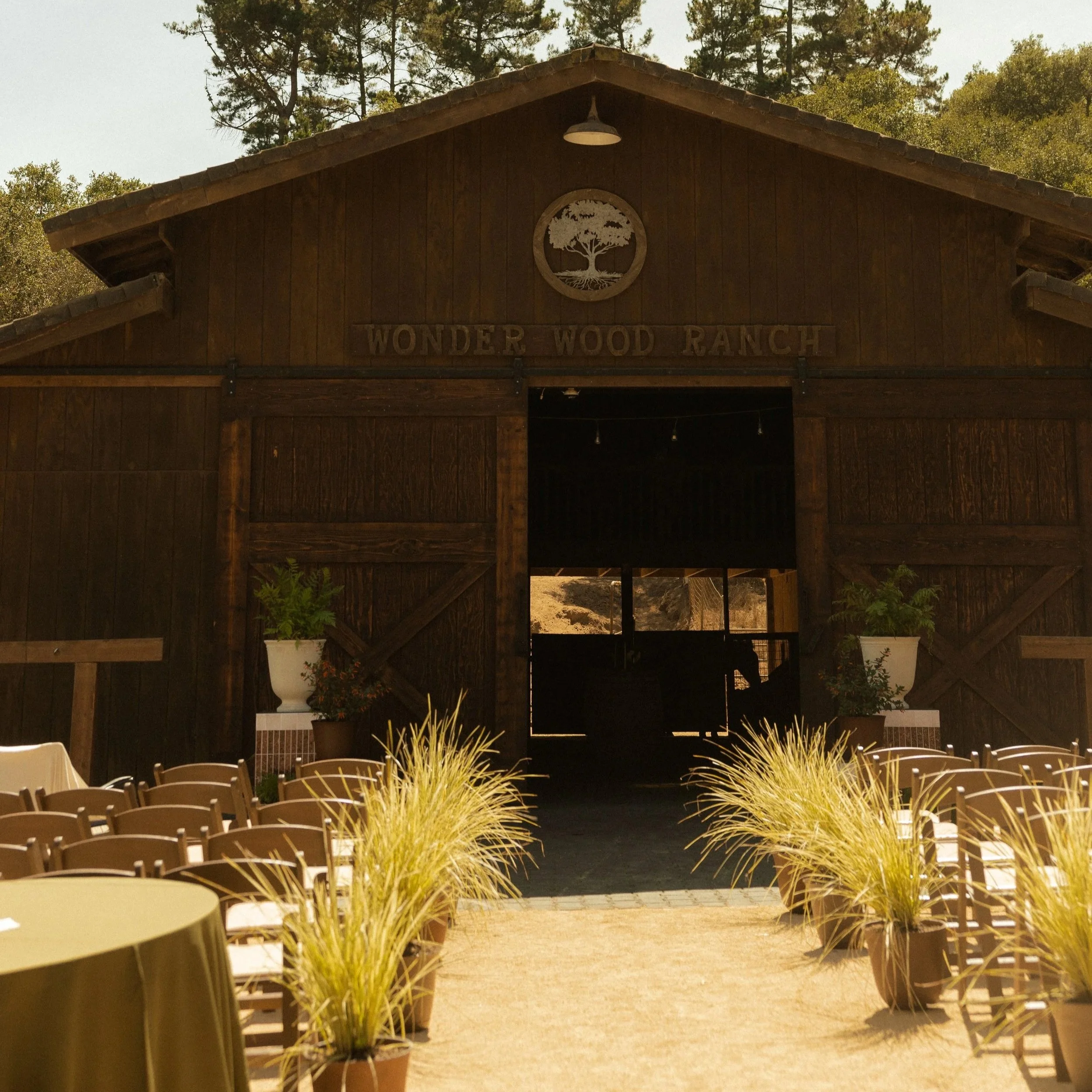
Photo credit to Kolby Danielle Photo
It was somewhere past nine, and the string lights had taken over the job of the beautiful California evening sun. I felt a soft tap. A guest I knew by name and not much else, one of Austin’s family friends. She placed a hand on my arm and told me she had just spent the better part of an hour talking to someone she had never met before that night, and that she could not remember the last time that had happened to her. Her face was just glowing.
I’m sure I replied in some typical way, but as she snagged a cookie from the table and walked away, I heard her words repeat in my mind.
She was the third person that night to tell me some version of the same thing.
Three times, something I’ve never heard before.
A hundred people or so were out to my family’s ranch for Austin and my wedding. Our two families and those closest to us there, most of whom have never met. Guests from several states. Many ages. Most of them never set foot on the property. What I had braced myself for were compliments about the oaks or the horses, because the those are the easiest things on that property to compliment.
Instead, three separate people came to tell me they had enjoyed the company of someone they didn’t know.
I have never received a better comment of anything I have created before.
What happened that night was not luck and it was not charm alone.
It was the output of a discipline I have been studying for years, applied to an evening instead of a site plan.
Landscape architecture, stripped down past the plant lists and the grading and the code, is the practice of arranging physical conditions so that human beings do something they would not otherwise do. Everything else is technique. When I design a courtyard for a restaurant, I am not producing just a courtyard. I am producing the odds that two people will linger there long enough to have a second drink. When I design a side yard for a family that has stopped going outside, I am producing the odds that someone walks out the door on a Tuesday to enjoy the morning light.
Hosting is the same discipline compressed into six or eight hours.
This is not a metaphor I invented. It is the thesis of the field.
In 1969, a man named William H. Whyte started pointing time-lapse cameras at plazas in Manhattan and simply watching what people did.[1] He did this for years and what he found overturned a great deal of confident professional opinion. One of his most useful discoveries was a phenomenon he named triangulation: the tendency of some external element, like a musician, a sculpture, a dog, an oddity, to give two strangers permission to speak to each other as though they were not strangers.[2] People, it turns out, are reluctant to open a conversation with someone they don’t know. They are not reluctant to comment on a third thing they are both looking at.
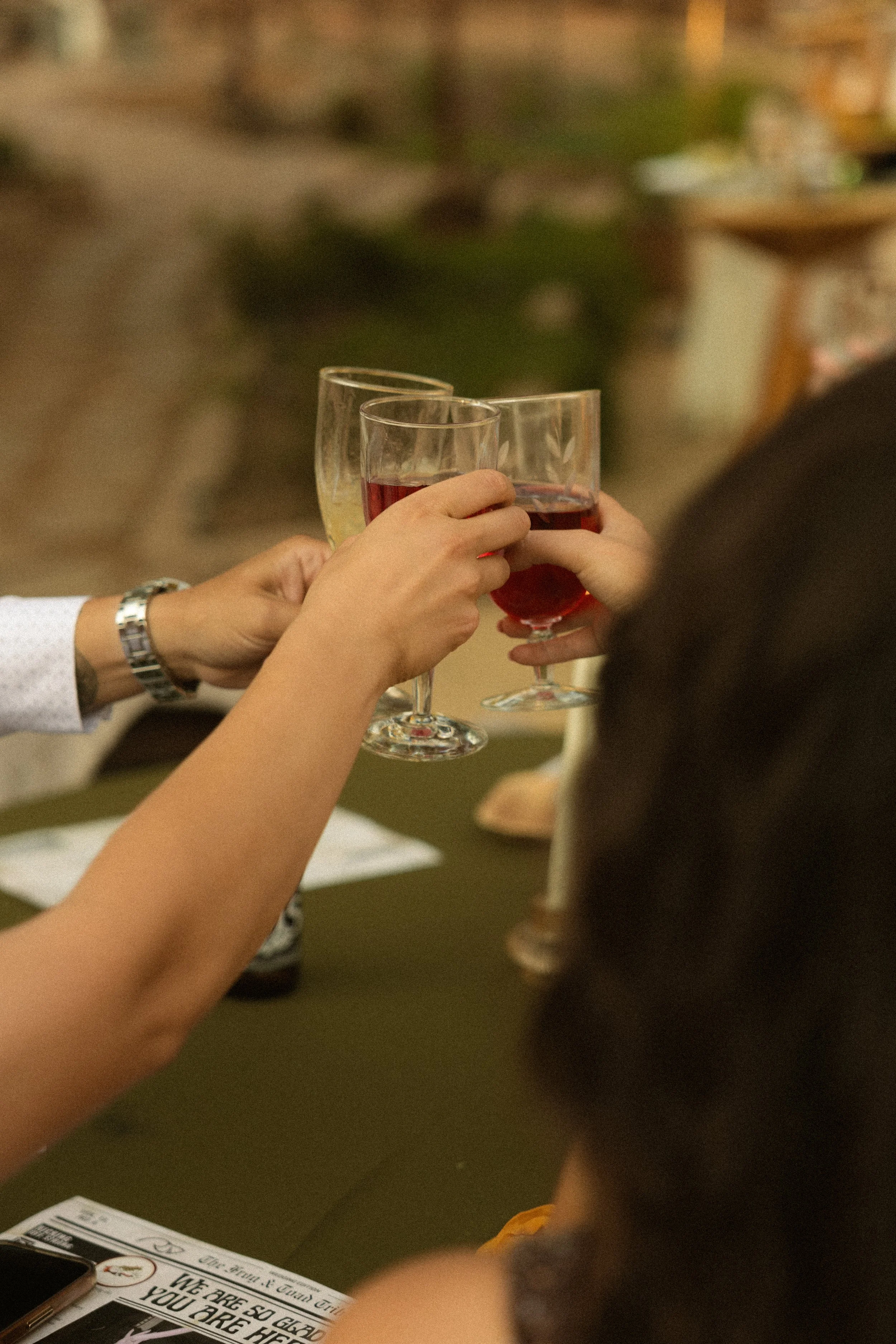
Photo credit to Kolby Danielle Photo
The third thing does the work. The design provides the third thing.
Once you see this, you cannot unsee it. The wedding itself was the third thing. But so was the band. And the dog asleep in an inconvenient location… the pot of chewed-off sticks I had decided not to remove, which I will write about another time. Every one of those was a doorway into a conversation that did not require anybody to be brave.
The sociologist Ray Oldenburg gave us the companion idea. He spent a career arguing that a community’s health depends on its third places… the cafés, taverns, barbershops and stoops that sit outside both home and work.[3] What defines them, in his account, is not the coffee. It is that they operate on neutral ground, that they flatten the status people carry in from the rest of their lives, that conversation is the main event rather than a byproduct, and that a newcomer is welcome without having to earn it.[4]
Read that list again and notice that not one item on it is a finish, a fixture, or a color. Every single one is a condition.
That is the part I want to press on, because it is the part the profession is the worst at communicating. A space is not good because it is beautiful. A space is good because of what becomes possible inside it. Beauty is frequently how you get there, comfort and delight lower a person’s guard faster than almost anything else, but beauty is the instrument. It was never the objective.
I keep returning to a moment from the ceremony. I was standing at the front, and while my uncle was speaking I let my eyes travel over the guests… my side, his side, people who had poured years into me, people I was still getting to know. Behind me, the two families were sitting mixed together because the seating had never been divided.
I have thought about that image for weeks now. Not because it was mine, but because it is the clearest picture I have of what this work is actually for. A place worth being in is a place where the distance between people gets a little shorter than it was when they walked in.
You can measure that.
The next time you walk into a space that’s working like a bar, a lobby, a friend’s back patio, a plaza that somehow always has people in it, try to identify the third thing. It’s almost always there, and it’s almost never the most expensive object in the room.
Sources for this post
William H. Whyte, The Social Life of Small Urban Spaces (1980) — findings from the Street Life Project, begun 1969, based on time-lapse filming and direct observation of eighteen Manhattan plazas.
Whyte’s concept of triangulation, defined as an external stimulus that prompts strangers to speak to one another as though they were not strangers. Social Life of Small Urban Spaces, ch. 11.
Ray Oldenburg, The Great Good Place (1989) — origin of the “third place” concept.
Oldenburg’s characteristics of third places: neutral ground, leveling of status, conversation as the main activity, strangers welcome. Summarized by Project for Public Spaces.
