

The Myth of Limitless Freedom
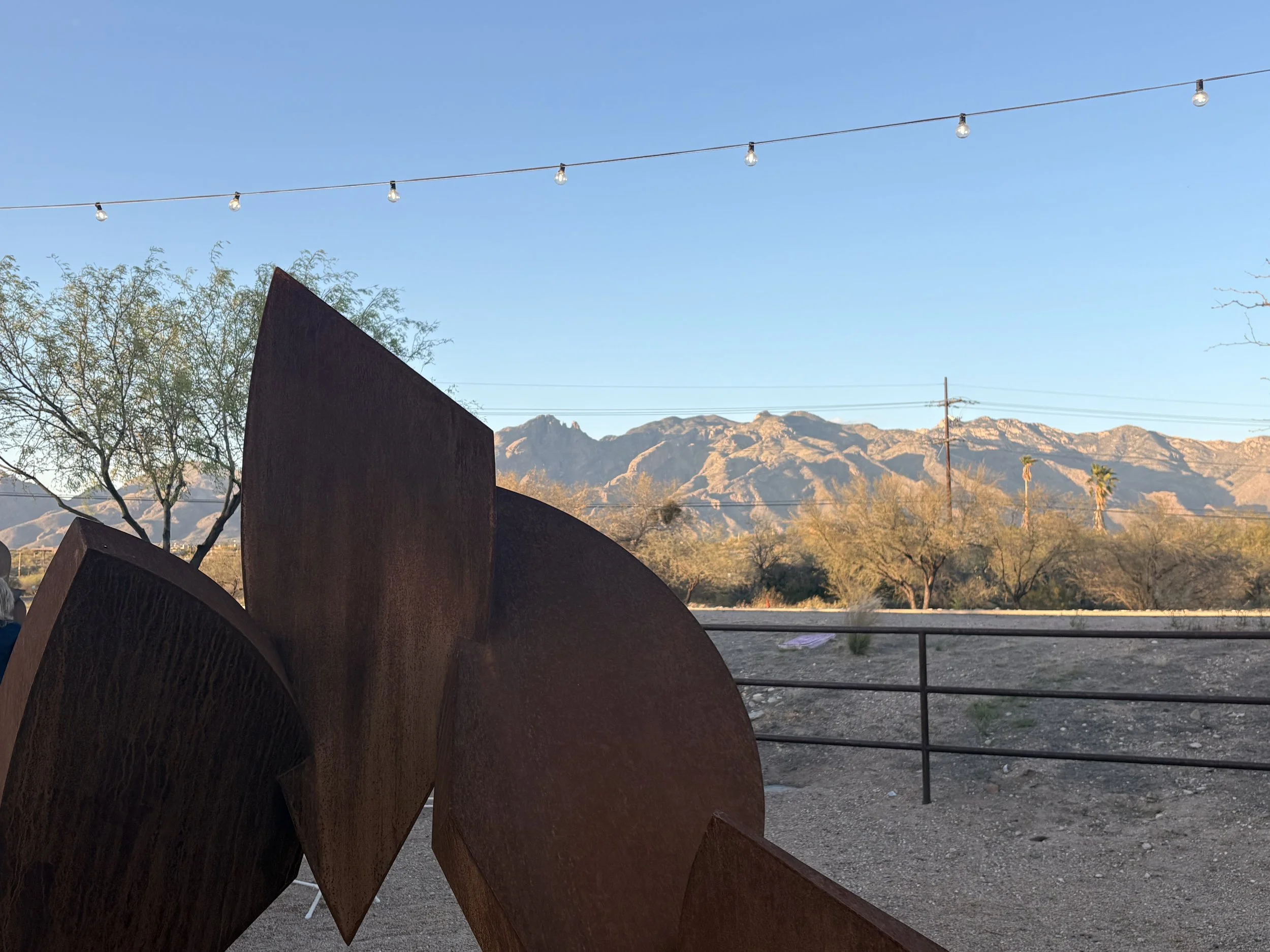
A sculpture by Hector Ortega mimicking the Catalina mountains.
If you read my last post, you know I don't believe in “the blank canvas”.
The idea that total creative freedom produces the best work is, I'd argue, one of the most persistent myths in design. Constraints don't kill creativity. They direct it. Context is what gives design meaning.
But here's where I want to take that thought a bit further (more than a bit actually).
Context alone isn't enough either. Surprise!
You can stand in front of a rich, complex, layered site, one that is genuinely full of story and opportunity, and still feel completely paralyzed. Not because the site has nothing to offer, but because without a structured way of moving through what you're seeing, all of that context just becomes a bunch of... noise.
Overwhelming, beautiful, directionless noise.
That's not a creativity problem. That's a process problem.
Context Without Process Is Just a Lot of Information
I've been there. Most designers have, I know.
You've done the research. You've walked the site. You've absorbed the history, the ecology, the human patterns, the light at different times of day. You know the place. And then you sit down to design and…
Nothing.
Suddenly you have forgotten everything. You’ve forgotten how to bubble diagram. Youve forgotten how to model. Youve forgotten how to even hold a pencil right!
Not because you lack vision or skill or heart. But because context, on its own, doesn't generate momentum. It generates data. And data without a framework for interpreting it doesn't become creativity. It becomes chaos.
This is where process earns its place.
A good process doesn't replace your intuition or override your instincts. It gives you a repeatable structure for turning raw context into something you can actually act on. It transforms information into insight, and insight into direction.
That's what creates creative momentum.
Drawn Out: Four Steps to Activate Creativity
This isn't a new idea. Anyone who's been through a serious design program has lived some version of this. But I keep coming back to it… in practice, when I'm stuck, when a project feels like it's spinning.
Observe - ground yourself in what is
Before creativity enters the room, understanding has to come first. This is the site inventory phase. You're not designing yet. You're noticing. Patterns. Constraints. Behaviors. The way water moves across the land. The way people cut through a space even when the path says otherwise. The gestures the environment is already making.
You cannot design for a context you haven't truly seen. And most of us, if we're being honest, move past this step too quickly.
Define - identify the real problem
This is where context becomes clarity. Site analysis. The so what of everything you just observed.
Context without definition is, as I like to say, just a bunch of hoopla. The act of naming what you're actually responding to, articulating the constraint or the opportunity in specific terms, forces vague impressions into a real problem statement. Not a feeling. Not a general direction. A defined question that your design is going to answer.
That definition is the foundation everything else gets built on.
Ideate - generate options, not answers
This is the concept phase. And this is the fun part!
Here you give yourself permission to explore broadly. Not to solve, but to possibility-find. You're leveraging everything the first two steps gave you and running it through all the different lenses. What could this be? What else could this be? How many ways could this problem be answered? What feels totally nuts?
This is where you expand what's feasible without losing sight of what's appropriate. The context you defined keeps you grounded. The permission to ideate keeps you moving. The combination of both is where interesting work starts to live.
Iterate - test, learn, refine
Any creative professional knows that real creativity is not linear.
It loops. It doubles back. It surprises you. You test something, it fails, and the failure teaches you something the original idea never could have. You refine. You test again. You get closer… not to a perfect solution, but to a true one.
This is essentially the scientific method applied to design. You form a hypothesis through your concept. You test it against the reality of the site, the budget, the human behavior, the construction logic. You get real feedback. You iterate.
And what comes out on the other side isn't just beautiful. It's earned. It's grounded in actual fact and actual testing. It works because it was proven to work! Not just because it looked good in a rendering.
The Scaffolding That Keeps Creativity Honest
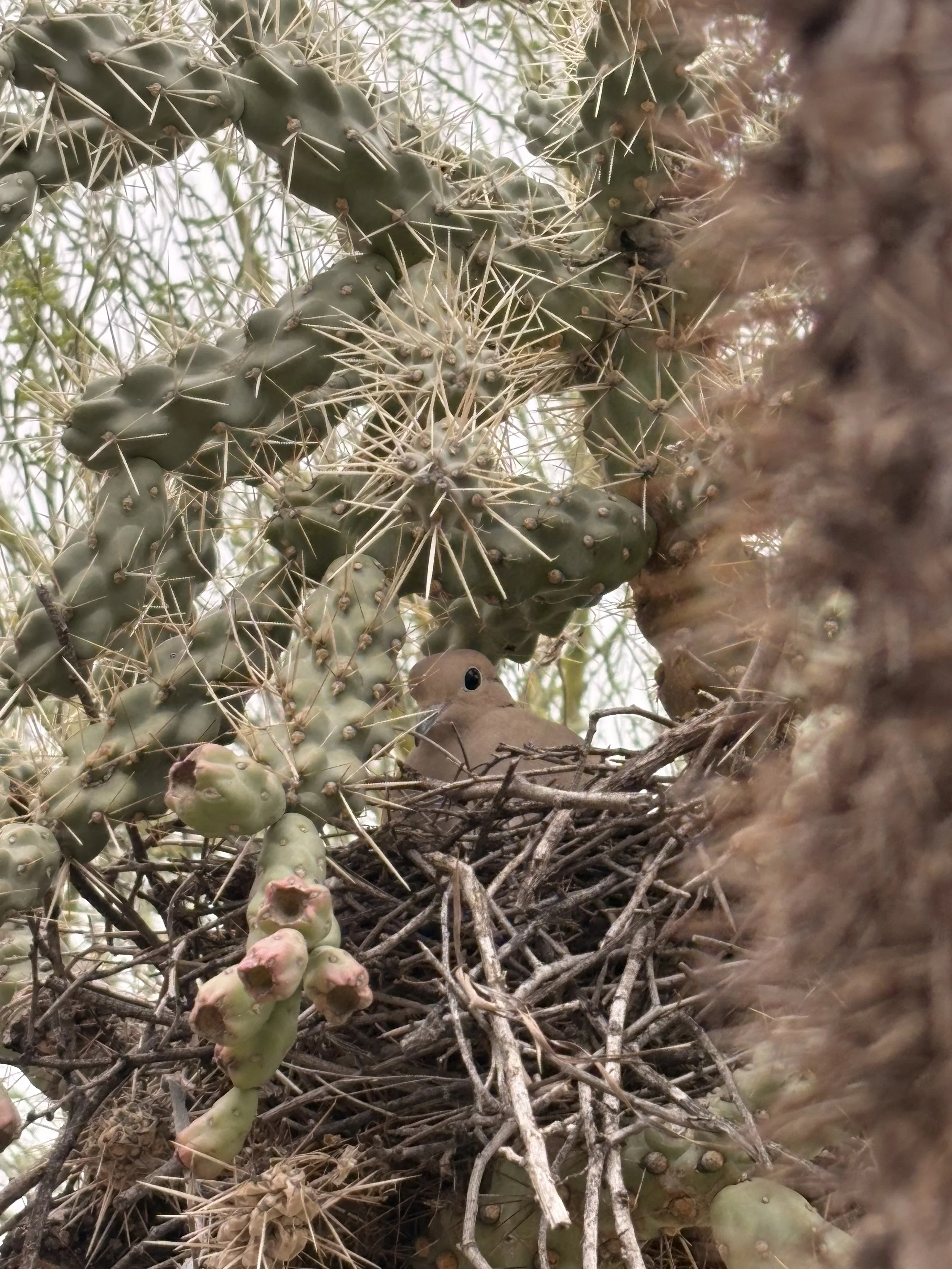
Talk about turning constraint into opportunity! This little morning dove created her nest within the pokey jumping cholla.
I want to be clear about something, because anyone who knows me knows I am not a rule follower.
I see a rule and I ask why. I push back. I question the framework before I adopt it.
So when I say process matters, I'm not saying creativity should be formulaic. I'm not saying every project moves through these four steps in a neat, tidy sequence. It doesn't. It never does.
What I am saying is that this kind of structure, or whatever shape it takes in your practice, is the scaffolding that keeps creative energy stable. It's not a cage. It's the thing that makes real creative freedom able to be constructed.
Without it, all that context just sits there. Unprocessed. Your ideas are unsupported. And that momentum, that aliveness you feel when a design is really moving, it just dies quietly :(
I come back to this framework every time I feel stalled. I ask myself: have I actually observed? Have I defined the real problem, or just a surface version of it? Am I in the ideation phase when I should still be in the definition phase? Have I been iterating, or have I been avoiding the discomfort of testing? Guilty. Guilty of that one often.
Slowing down and returning to the structure almost always unlocks something new for me.
Every Constraint Becomes an Opportunity
That's what I want to leave you with.
When process is working, the boundaries stop feeling like limitations. They start feeling like the specific conditions your design gets to respond to. The problem statement becomes the creative brief. The constraint becomes the ingenuity-shaper.
Creativity becomes less abstract and more systematic… and somehow, paradoxically, more creative for it.
Process doesn't suppress the work. It makes room for your brain to actually do it.
I'm curious: what framework, if any, do you return to when creativity stalls? Does context alone ever feel like too much without a method to move through it? And when you're stuck, what gives you that first spark of new momentum?
